


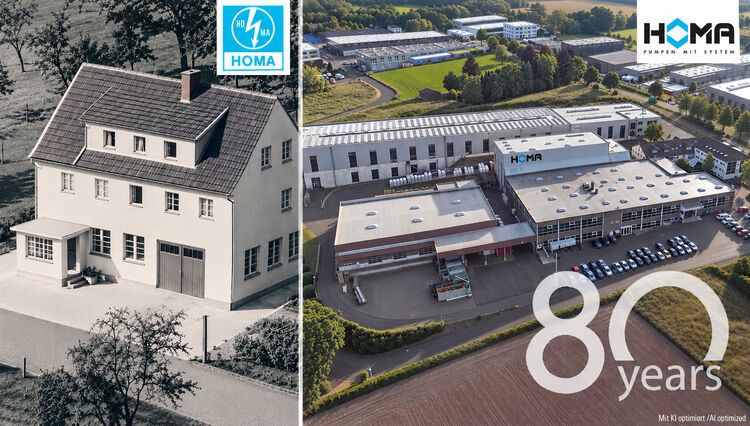
Neunkirchen-Seelscheid, 10.11.2026 – Companies evolve as the needs of their customers and markets change. HOMA’s history is a case in point. When Hans Hoffmann founded his electric motor repair workshop in 1946, the focus was initially on solving individual technical problems for his customers.
Just a few years later, the company began manufacturing its own electric motors. In 1950, its decision to specialise in submersible motor pumps marked the decisive step towards the pump technology HOMA is known for today. The repair of existing equipment gave way to the development of its own products – and, over time, individual products evolved into increasingly comprehensive solutions for managing water and wastewater.
From Pumps to Complete System Solutions
As customer requirements evolved, so did HOMA’s product range. Pumps for municipal and industrial wastewater applications were joined by solutions for agriculture and building services. Today, the portfolio ranges from submersible wastewater pumps and grinder pumps to lifting stations, pump stations and mixers, as well as pump control and automation systems. The focus is no longer solely on the individual pump, but on providing the right solution for a specific task – from drainage and pumping to the collection, treatment and safe transport of wastewater.
The wide range of applications is reflected in the locations where HOMA products are used around the world. They can be found in infrastructure and construction projects such as The Palm Jumeirah in Dubai, Ferrari World theme park in Abu Dhabi, the Panama Canal and the Louvre in Paris.
Over the decades, HOMA has evolved from a regional manufacturer into an internationally active company. Today, it employs nearly 300 people at its headquarters in Neunkirchen-Seelscheid and is represented in international markets through its own subsidiaries, branches and partners.
Growing Where Challenges Are Growing
An international outlook is becoming increasingly important to the company’s future development, with Asia being a particular focus. Population growth, urbanisation and infrastructure expansion pose major challenges, especially for countries such as India, in the collection, pumping and treatment of wastewater. At the same time, demand for reliable and cost-effective pump and system technology is growing.
HOMA therefore aims to combine its technological experience more closely with local market knowledge, production and sales. The company has been present in Southeast Asia through HOMA Pump Asia in Malaysia since 2021. In India, HOMA is further developing its joint venture, EKKI-HOMA, together with its partner EKKI.
The aim is to develop products and solutions specifically tailored to the needs of the Indian market and neighbouring countries. This gives HOMA a platform from which to participate in the long-term development of these markets while moving closer to customers and regional requirements. Greater internationalisation does not mean turning away from Germany. On the contrary, Neunkirchen-Seelscheid remains the company’s technological and industrial foundation.
Vertical Integration as a Strategic Strength
One of HOMA’s key strengths is its high level of in-house manufacturing, which is extensive by international standards. Key components for its pumps and motors are developed and manufactured at the company’s own site.
For decades, this has primarily represented technical expertise, quality and flexibility. In today’s global economic environment, it has taken on even greater significance. Uncertain supply chains, trade disputes, tariffs, geopolitical fragmentation and rising transport costs demonstrate the value of having strong in-house industrial capabilities.
“Today, our high level of vertical integration means more to us than just quality and technical expertise. It ensures our independence from suppliers and makes us more resilient in the face of supply chain issues, geopolitical changes, and increasing trade barriers. Maintaining this capability here in Germany is therefore a deliberate strategic decision,” explains Hans Hoffmann, third-generation Managing Director of HOMA Pumpenfabrik GmbH.
However, this independence comes at a cost: an industrial location such as Germany can only remain competitive globally if productivity and efficiency are continuously improved. That is why HOMA is making targeted investments in modern machinery, automation and optimised production processes. In recent years, tens of millions of euros have been invested at the Neunkirchen-Seelscheid site. Production capacity has been expanded, processes automated and lead times reduced.
Technology Needs Expertise
Modern machinery alone, however, is not enough to ensure competitiveness. The foundation of HOMA’s high level of vertical integration is the expertise its employees have built up over decades. From development and motor and pump manufacturing to assembly and testing, HOMA has a range of in-house capabilities that are often spread across different suppliers elsewhere. This knowledge enables the company to further develop its products, adapt processes and integrate new technologies effectively into existing manufacturing operations.
“The foundation of our vertical integration is the knowledge of our employees. It is only because we have this experience and expertise within the company that we can develop and manufacture key parts of our products ourselves. Our task now is to combine this knowledge with automation, digitalisation and better processes. This is the only way we can secure the long-term international competitiveness of our site in Germany,” says Hoffmann.
Practical experience gained in day-to-day production also plays an important role. Employees are therefore involved in the ongoing development of workflows and manufacturing processes and are prepared for new technologies and requirements.
Managing Director Michael Sulzbach: “Our employees have an in-depth understanding of our processes and day-to-day requirements. Combining this knowledge with modern manufacturing technologies is a key factor in enabling us to improve productivity and quality at the same time.”
80 Years of Experience – and a Clear Direction
HOMA’s development follows a clear trajectory: a repair workshop became a manufacturer, individual pumps evolved into system solutions, and a regional business grew into an international supplier. The years ahead will bring further change. Global demand for solutions for water and wastewater is increasing, while the conditions in which industrial companies operate are also evolving.
HOMA aims to bring these developments together: to seize new growth opportunities, particularly in Asia, while strengthening its technological expertise and industrial base in Germany, and to remain internationally competitive through automation and continuous process optimisation. The family-owned company sees its 80th anniversary not so much as a look back, but as the starting point for its next phase of development.